Picture this. It’s 2019.
You’re a student trying to figure out why your code isn’t working. So you open Google, type in your doubt, and spend the next 45 minutes going down a rabbit hole — Stack Overflow, MDN docs, some random blog from 2015 that somehow explains it perfectly. It’s a little painful. But by the end of it? You get it. Like, actually get it.
Now picture 2025.
Same problem. You open ChatGPT, type the question, and get a clean answer in 10 seconds. Done.
Faster, right? Sure. But here’s the thing — Are you actually learning?
I came across this post on Reddit recently. A senior engineer at a FAANG company was venting about the new grads on his team.
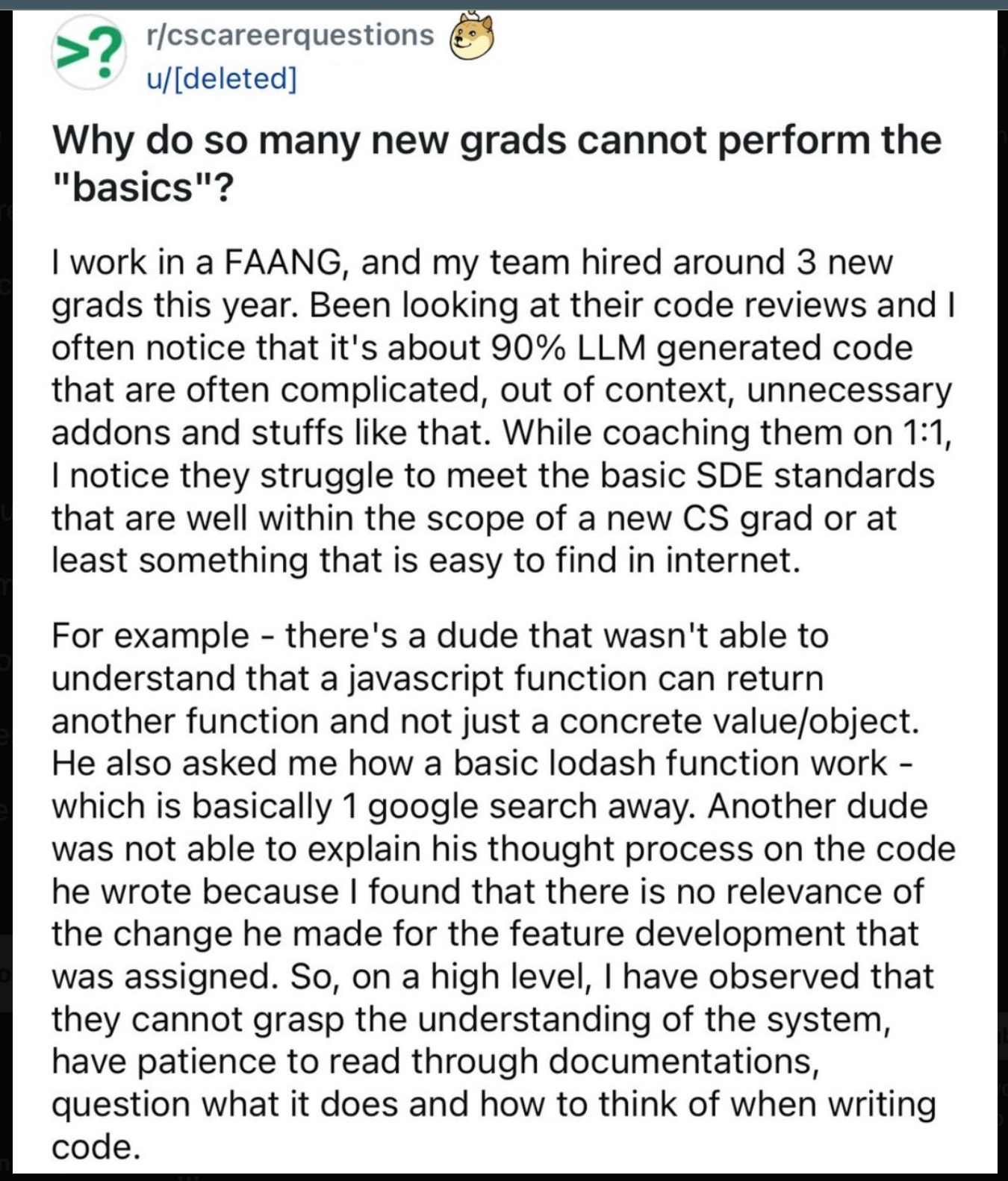
He noticed that about 90% of their code looked like it was straight out of an AI prompt. When he sat down with them one-on-one, things got worse. One of them didn’t understand that a JavaScript function could return another function. Another couldn’t explain why he wrote the code he did — because the code had nothing to do with the feature he was building.
These weren’t bad students. They cracked FAANG interviews. That’s no joke. But when it came to real work? They were lost.
This is what I call shallow knowledge — and it’s quietly becoming an epidemic.
Surface vs. Core
There are two kinds of knowledge.
Shallow knowledge is when you know what something does but not how or why. You can use it, but you can’t think with it. The moment something breaks or goes out of context, you’re stuck.
Deep knowledge is when you understand the fundamentals so well that you can apply them anywhere — even in situations you’ve never seen before.
Those new grads? They had enough shallow knowledge to pass interviews. But they didn’t have the deep knowledge to survive on the job. They couldn’t review AI-generated code. They couldn’t catch when it was wrong. They couldn’t explain their own PRs.
And honestly, it makes sense. If you’ve never had to struggle through understanding something — if the answer always came before you even felt the pain of not knowing — why would your brain bother building those deep foundations?
What We Lost in the Shortcut
Here’s the thing nobody talks about: the struggle was the learning.
When you used to Google something, you didn’t just find an answer. You read three wrong answers first. You tried something, broke it, tried again. You built intuition — that quiet, background sense of how things work that kicks in when you’re stuck at 2am and Stack Overflow has nothing.
AI skips all of that. And in doing so, it quietly takes away the most important part of learning — the curiosity to figure things out.
When answers are instant, questions stop feeling interesting. And when questions stop feeling interesting, learning stops.
So... Is AI the Problem?
No. I want to be clear about that.
The problem isn’t AI. The problem is how we’re using it.
Think about it this way. Before, you’d search Google and visit a bunch of links to understand something. Now, you go to ChatGPT instead. The tool changed, but the approach doesn’t have to.
The question is: are you using AI to find answers, or to understand them?
There’s a big difference. If you get an answer and move on — you’ve found it. If you get an answer and then ask “wait, why does that work?” and keep digging — you’re understanding it.
One builds shallow knowledge. The other builds deep knowledge. The tool is the same. The choice is yours.
The Right Way to Learn in 2026
Use AI. Seriously, use it. It’s an incredible resource. But treat it like a really smart tutor, not like a copy-paste machine.
When you’re learning something new — don’t just take the first answer. Ask follow-up questions. Break things on purpose. Try to explain the concept back to the AI and see if it corrects you. Go down the rabbit hole, just with a faster guide.
The fundamentals still matter. Variables, functions, how data flows, why systems are built the way they are — these things don’t change just because AI can write the code for you. If anything, they matter more now, because the only thing that separates a good engineer from an AI is the ability to think about the problem.
The graduates in that Reddit post didn’t fail because they used AI. They failed because they used it to skip understanding. Don’t make that mistake.
The fastest way to learn has always been to actually care about how things work. AI just lets you do that faster now — if you let it.