In the early 1980s, software development was at a crossroads. At places like MIT, where Richard Stallman worked, software had always been shared freely — anyone could modify, improve, and distribute it.
But by the late ’70s, the world was changing. Software was becoming proprietary, locked behind licenses, and companies were now selling what had once been freely distributed. For Stallman, this shift felt like a betrayal. This is not how software should be used!
The Turning Point
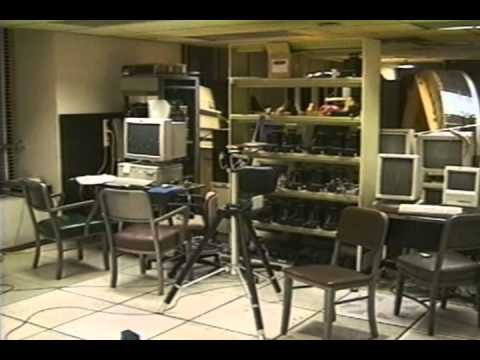
Stallman’s frustration came to a head over something seemingly mundane: a printer. The AI lab at MIT had been using a printer for which Stallman had modified the software to notify users when their jobs were complete. When the lab got a new printer, Stallman requested the source code to make the same modifications — but the company refused. They had made their software proprietary.
For Stallman, this was more than an inconvenience — it was a sign that the entire software industry was heading in the wrong direction, towards restricting users’ freedom to modify and share programs.
The Bold Decision: Quitting MIT
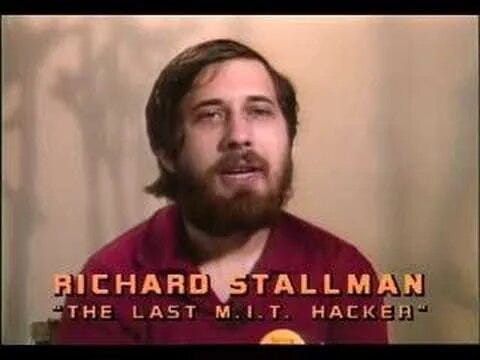
In 1983, Stallman made a life-changing decision: he quit his job at MIT to start a revolutionary project. He publicly announced that he would create a free operating system — one that anyone could use, modify, and share without restrictions. This project became the GNU Project (short for “GNU’s Not Unix”), a free Unix-like operating system.
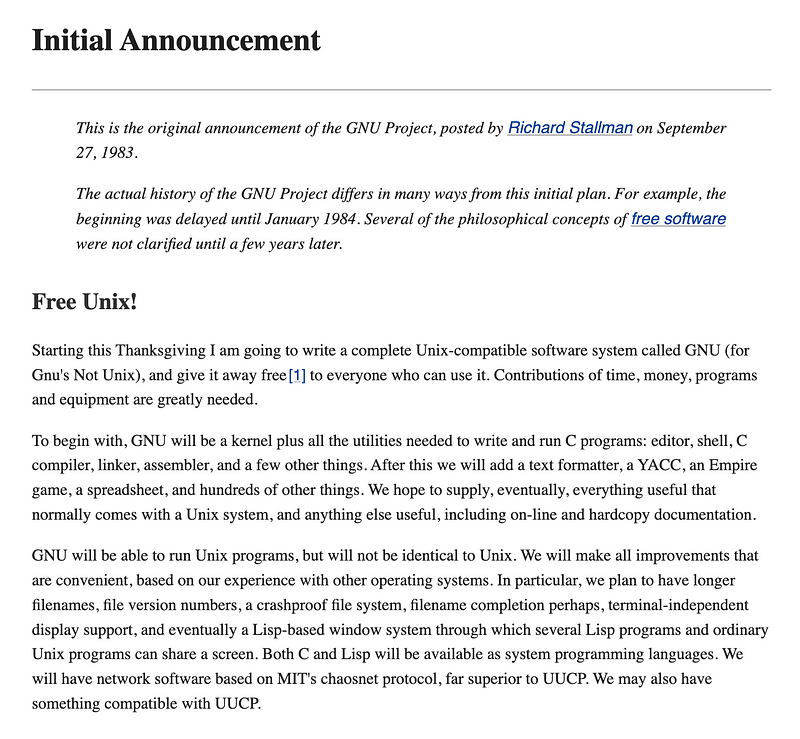
Stallman’s vision was not just about creating software; it was about preserving freedom in utilizing software. He believed users should have control over their software, and the GNU Project would ensure that by creating completely free software.
Building GNU: A Free Software Foundation
Over the next few years, Stallman and his collaborators began building the essential components for the GNU system. Tools like Grep, Tar, and Bash — programs still widely used today — were developed as part of the GNU Project. But just as important as the software was the legal framework Stallman created to protect it: the GNU General Public License (GPL). The GPL ensured that any software distributed under its terms would remain free for all users. It was a legal and philosophical statement that software should be open and modifiable.
However, despite this progress, the GNU system lacked one crucial component: a working kernel. The team initially worked on building a fully functional kernel that could power the GNU Operating System, thereby making a fully functional OS. But unfortunately, the Hurd didn’t perform all that well and they had to drop it!
The kernel is the core part of any operating system, responsible for managing hardware and system resources. Without it, GNU was incomplete.
But there was a student at the University of Helsinki, Finland, who was working on a hobby project. Well, he had the ultimate solution!
Guess who?